AI Data Privacy Compliance: US Business Updates Mid-2026

Anúncios
AI Data Privacy Compliance: Essential Updates for US Businesses by Mid-2026
The rapid advancement of Artificial Intelligence (AI) has brought forth unprecedented opportunities for innovation and efficiency across various industries. However, this technological leap also ushers in a complex web of ethical considerations and regulatory challenges, particularly concerning data privacy. For US businesses, navigating the evolving landscape of AI Data Privacy Compliance is not just a legal obligation but a cornerstone for building consumer trust and maintaining a competitive edge. As we approach mid-2026, a series of crucial updates and emerging regulations demand immediate attention and proactive strategies.
Anúncios
The intersection of AI and data privacy presents a dynamic and often ambiguous regulatory environment. While the European Union’s General Data Protection Regulation (GDPR) has long set a global benchmark, the United States has traditionally adopted a more sectoral and state-specific approach. However, the proliferation of AI and its profound impact on personal data processing has accelerated calls for more comprehensive and harmonized federal regulations. Businesses that fail to anticipate and adapt to these changes risk significant financial penalties, reputational damage, and a loss of consumer confidence.
Anúncios
The Evolving Landscape of US Data Privacy Laws
Unlike the EU’s singular GDPR, the US data privacy landscape is a patchwork of federal and state laws. Key federal statutes like HIPAA (for healthcare data) and COPPA (for children’s online privacy) address specific sectors or demographics. However, the most significant developments in recent years have come from state-level initiatives, particularly those influenced by the California Consumer Privacy Act (CCPA) and its successor, the California Privacy Rights Act (CPRA).
State-Level Privacy Acts and Their AI Implications
The CCPA/CPRA has served as a blueprint for numerous other state privacy laws, including the Virginia Consumer Data Protection Act (VCDPA), the Colorado Privacy Act (CPA), the Utah Consumer Privacy Act (UCPA), and the Connecticut Data Privacy Act (CTDPA). While each has its nuances, they generally grant consumers more control over their personal data, including rights to access, delete, and opt-out of the sale or sharing of their information. The critical implication for AI lies in how these laws define and regulate the collection, processing, and use of data that fuels AI algorithms.
For instance, provisions related to automated decision-making and profiling are becoming increasingly common. Businesses utilizing AI for personalized marketing, credit scoring, employment decisions, or even content moderation must understand how these processes intersect with individuals’ privacy rights. The concept of ‘sensitive personal information’ is also expanding, often encompassing biometric data, precise geolocation data, and even data inferred from AI analysis, which can reveal sensitive attributes about an individual.
Emerging Federal AI Data Privacy Compliance Discussions
While a comprehensive federal privacy law akin to GDPR remains elusive, there is growing bipartisan consensus on the need for federal intervention, particularly concerning AI. Discussions in Congress revolve around several key areas:
- Data Minimization: Encouraging or mandating that AI systems only collect and process data strictly necessary for their intended purpose.
- Transparency and Explainability: Requiring businesses to be transparent about how AI systems use data and, in some cases, to explain automated decisions to individuals.
- Bias and Fairness: Addressing the potential for AI algorithms to perpetuate or amplify biases based on protected characteristics, often stemming from biased training data.
- Data Security: Reinforcing robust security measures to protect the vast quantities of data processed by AI systems from breaches and unauthorized access.
- Individual Rights: Expanding and standardizing individual rights concerning their data in AI contexts, including the right to opt-out of certain AI-driven processing.
By mid-2026, it is highly probable that we will see either significant progress on a federal AI-specific privacy framework or a more harmonized approach to state-level regulations. Businesses cannot afford to wait for definitive legislation; proactive measures are essential.
Key Challenges for US Businesses in AI Data Privacy Compliance
The journey towards robust AI Data Privacy Compliance is fraught with challenges. Understanding these hurdles is the first step towards overcoming them.
Defining and Managing AI-Specific Personal Data
Traditional definitions of personal data are being stretched by AI. AI systems often generate new data points or inferences about individuals that were not explicitly collected. For example, an AI analyzing shopping patterns might infer a user’s health conditions, creating new categories of sensitive data. Businesses need to develop sophisticated data mapping and classification strategies that account for these AI-generated insights.
Transparency and Explainability of AI Decisions
One of the most significant challenges is the ‘black box’ nature of many advanced AI models. Explaining how an AI arrived at a particular decision, especially when it impacts an individual (e.g., loan approval, job application rejection), is technically complex. However, regulators are increasingly demanding greater transparency. Businesses must invest in explainable AI (XAI) techniques and clear communication strategies to meet these expectations.
Mitigating Algorithmic Bias
AI models are only as good as the data they are trained on. If training data reflects societal biases, the AI will likely perpetuate and even amplify those biases. Addressing algorithmic bias requires careful data curation, bias detection tools, and continuous monitoring. Non-compliance in this area can lead to significant legal and reputational repercussions, especially under anti-discrimination laws.
Cross-Border Data Transfers and International Implications
Many US businesses operate globally, and their AI systems often process data from various jurisdictions, including the EU. This introduces complexities related to cross-border data transfer mechanisms, such as Standard Contractual Clauses (SCCs), and ensuring compliance with multiple, sometimes conflicting, international privacy regimes like GDPR. The need for robust data localization strategies or certified data transfer frameworks becomes paramount.
Ensuring Data Security for AI Systems
AI systems often require massive datasets, making them attractive targets for cybercriminals. Protecting this data from breaches, unauthorized access, and manipulation is critical. This involves implementing advanced encryption, access controls, threat detection, and incident response plans specifically tailored for AI environments. The interconnected nature of AI components can also create new vulnerabilities that need to be addressed.
Essential Strategies for US Businesses by Mid-2026
To effectively navigate the evolving landscape of AI Data Privacy Compliance, US businesses must adopt a proactive and multi-faceted approach.
1. Conduct Comprehensive Data Audits and Mapping
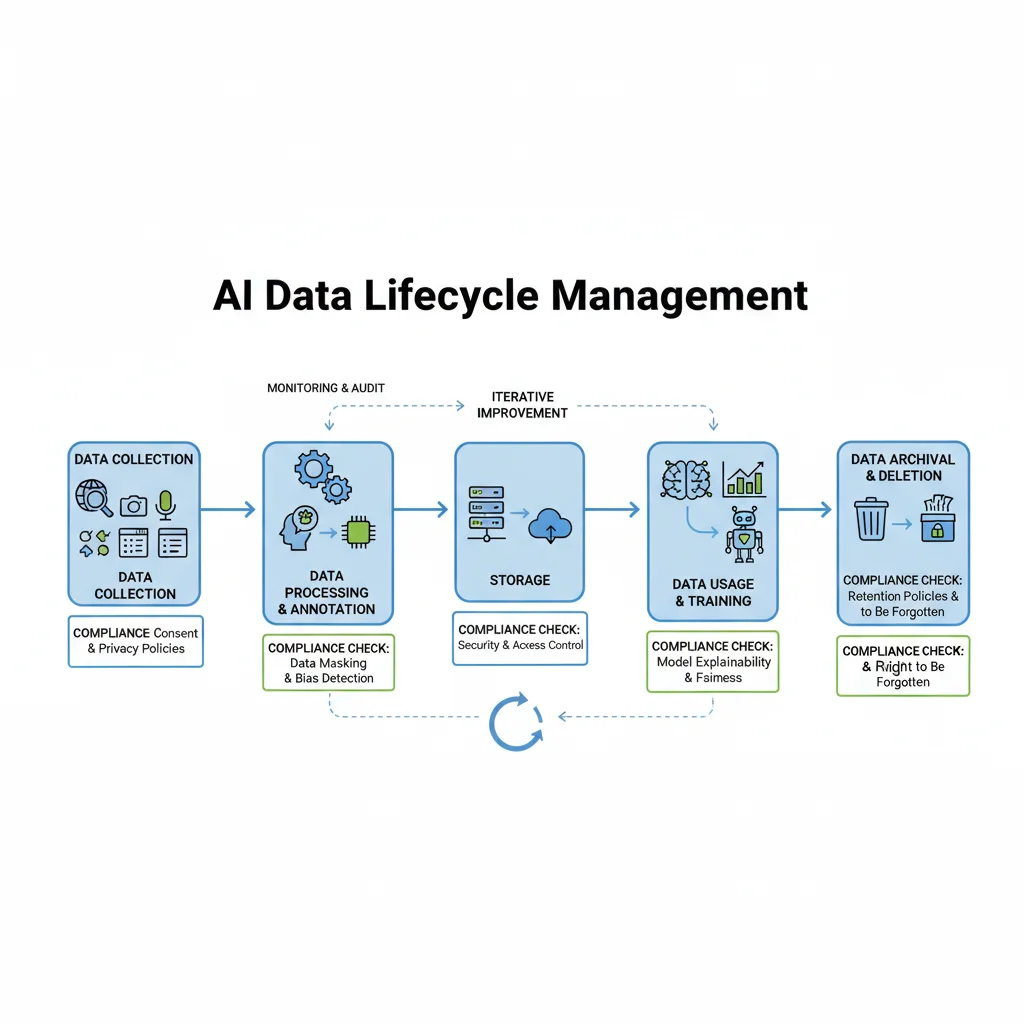
Before implementing any AI solution, businesses must have a clear understanding of the data they collect, how it’s used, where it’s stored, and who has access to it. This requires detailed data mapping, identifying all data flows, and classifying data based on its sensitivity and regulatory requirements. For AI, this audit must extend to identifying all data used for training, testing, and operating AI models, including any inferred data.
2. Implement a Robust Data Governance Framework for AI
A strong data governance framework is foundational. This includes:
- Clear Policies and Procedures: Develop specific policies for AI data collection, usage, retention, and deletion that align with current and anticipated privacy regulations.
- Roles and Responsibilities: Define clear roles for data ownership, stewardship, and privacy compliance within AI projects. Consider appointing a dedicated AI Ethics or Privacy Officer.
- Data Minimization by Design: Integrate privacy-by-design principles into the AI development lifecycle, ensuring that only necessary data is collected and processed.
- Data Quality and Integrity: Establish processes to ensure the accuracy, completeness, and relevance of data used in AI, which is crucial for mitigating bias and ensuring reliable outputs.
3. Prioritize Privacy-Enhancing Technologies (PETs)
PETs are tools and techniques designed to minimize personal data processing while achieving desired outcomes. Examples include:
- Anonymization and Pseudonymization: Techniques to remove or obscure direct identifiers from data, making it harder to link back to individuals.
- Homomorphic Encryption: Allows computations on encrypted data without decrypting it, preserving privacy during processing.
- Differential Privacy: Adds controlled noise to data to prevent individual identification while still allowing for aggregate analysis.
- Federated Learning: Enables AI models to be trained on decentralized datasets without the need to centralize raw data, enhancing privacy.
Investing in and integrating PETs can significantly reduce privacy risks associated with AI deployments.
4. Enhance Transparency and User Control
Consumers are increasingly demanding transparency regarding how their data is used, especially by AI. Businesses should:
- Provide Clear Privacy Notices: Inform users in plain language about the types of data collected, how AI uses it, and their rights.
- Offer Granular Consent Mechanisms: Allow users to consent to specific data uses by AI, rather than broad, all-encompassing terms.
- Facilitate Data Subject Rights: Establish clear and efficient processes for individuals to exercise their rights to access, rectify, delete, and port their data, and to opt-out of certain AI-driven profiling or automated decision-making.
- Develop Explainable AI (XAI) Interfaces: Where possible, provide simplified explanations of how AI models arrive at decisions, especially in high-stakes scenarios.
5. Implement Robust Security Measures
The security of AI systems and the data they process is non-negotiable. This involves:
- Secure Data Storage and Transmission: Encrypt data at rest and in transit.
- Access Controls: Implement least privilege access, multi-factor authentication, and regular access reviews for AI data and systems.
- Vulnerability Management: Regularly scan AI systems and underlying infrastructure for vulnerabilities and patch them promptly.
- Threat Detection and Response: Deploy AI-powered security tools to detect and respond to anomalies and potential breaches in real-time.
- Supply Chain Security: Vet third-party AI vendors and data providers to ensure their security practices align with your own.
6. Conduct Regular Privacy Impact Assessments (PIAs) and Data Protection Impact Assessments (DPIAs)
For any new AI project or significant change to an existing one, conduct a PIA or DPIA to identify and mitigate privacy risks. These assessments should be ongoing and iterative, adapting as AI models evolve and new data is introduced.
7. Invest in Employee Training and Awareness
Human error remains a leading cause of data breaches. Regular and comprehensive training for all employees involved in AI development, deployment, or data handling is crucial. This training should cover privacy regulations, company policies, and best practices for secure data handling and AI ethics.
8. Monitor Regulatory Developments and Engage with Legal Counsel
The regulatory landscape is dynamic. Businesses must continuously monitor legislative changes at both federal and state levels. Engaging with legal counsel specializing in AI and data privacy is essential to interpret complex regulations and ensure ongoing compliance.

The Broader Impact of AI Data Privacy Compliance
Beyond avoiding penalties, prioritizing AI Data Privacy Compliance offers significant strategic advantages:
Building Consumer Trust and Brand Reputation
In an era of heightened privacy concerns, businesses that demonstrate a strong commitment to protecting user data and using AI responsibly will differentiate themselves. Trust is a valuable currency, and a robust privacy posture can significantly enhance brand reputation and customer loyalty.
Fostering Ethical AI Innovation
Compliance often drives ethical considerations. By embedding privacy and fairness into AI design, businesses can foster more responsible and sustainable AI innovation. This can lead to the development of AI solutions that are not only powerful but also socially beneficial and equitable.
Competitive Advantage
Early adopters of comprehensive AI data privacy frameworks will be better positioned to adapt to future regulations and capitalize on opportunities that arise from a trusted AI ecosystem. Companies that lag behind risk being sidelined by more compliant competitors.
Minimizing Legal and Financial Risks
The financial penalties for data privacy violations are steep, and the legal costs associated with defending against lawsuits can be astronomical. Proactive compliance is a cost-effective strategy for minimizing these risks.
Conclusion: A Proactive Stance is Imperative
The landscape of AI Data Privacy Compliance in the US is rapidly evolving, with mid-2026 serving as a critical juncture for anticipated regulatory shifts. For US businesses, the time for a reactive approach has passed. A proactive, strategic commitment to understanding, implementing, and continuously adapting to these privacy updates is not merely about avoiding penalties; it’s about building a foundation of trust, fostering ethical innovation, and securing a sustainable future in the AI era.
By conducting thorough data audits, establishing robust governance frameworks, embracing privacy-enhancing technologies, prioritizing transparency, and investing in continuous security measures and employee training, businesses can confidently navigate the complexities of AI Data Privacy Compliance. The future of AI is intertwined with responsible data stewardship, and those who embrace this principle will be the leaders of tomorrow.